


Your plants are struggling and someone tells you to check your soil pH. So you buy a tester, push it into the ground, read a number, and act on it.
I want to show you why that number is often worth less than you think, and what to do instead. Part of my training covered quality control of chemical and environmental measurements, which is the unglamorous side of science concerned with whether a reading means anything at all. It leaves you with a habit: before trusting a number, ask how it was produced and how far off it could be.
Soil pH is a good example, because the way these testers are sold hides how large the error can be.
Why “Accurate to Within One pH Unit” Is Not Reassuring
Extension trials have compared cheap home test kits against laboratory analysis. South Dakota State Extension found that the kits generally estimated soil pH within one unit of the lab result, and in their own tables one kit read pH 8 on a soil the laboratory measured at 6.2.
That phrase gets quoted as though it settles the matter. It does not, because of how the pH scale works.
pH is logarithmic. Each whole number is a tenfold change in acidity. So soil at pH 5.0 is ten times more acid than soil at pH 6.0, not slightly more acid. A tester that is accurate to within one unit can tell you 6.0 when your soil is 5.0, and you would never know from the display. The 1.8 unit gap in that trial is a difference of more than sixtyfold.
That range spans the difference between soil most vegetables grow happily in and soil acid enough to lock up phosphorus and stunt them. The tester is not lying to you. It is doing what it was built to do, and the margin is simply far larger than the confident digital readout suggests.
The Types, and What Each One Is Good For
Two-prong analogue probes.
The cheapest and most common, usually no battery, often sold as three-in-one with moisture and light. You push the metal prongs into soil and read a dial. These respond to how well the soil conducts electricity, which is affected by moisture, salts and compaction as much as by acidity. Treat the reading as a rough impression, not a measurement.
Chemical colour kits.
Soil is mixed with a reagent and the colour compared against a chart. The chemistry is sound, but your eye is the weak point, since the colour bands sit close together and lighting changes what you see. Montana State Extension rates a meter as more reliable than a colour comparison for this reason, because reading a number leaves less room for interpretation than judging a shade.
Digital pens with a glass electrode.
The type used in laboratories, scaled down. These measure hydrogen ion activity directly, which is what pH actually is. They need calibrating against buffer solutions and they are usually designed to read a liquid, so you mix soil with distilled water and test the slurry rather than stabbing the ground. More work, and far more trustworthy.
A laboratory test.
You post a sample and receive a result. Montana State Extension makes the case bluntly: home kits differed moderately or greatly from laboratory results, and given that lab fees start around the price of a kit, it is better to spend the money on a result you can act on than to fertilise based on a wrong one.
What I Would Buy
If you want one number you can act on, do not buy a tester at all. Send a sample to a laboratory. You get a pH you can trust, plus nutrient levels, for roughly what a mid-range meter costs. Soil pH moves slowly, so this is a once every few years job rather than a running expense.
If you want to watch for change over time, buy a digital pen with a glass electrode and calibration. Its strength is consistency.
Check the Apera PH20 pH Tester on Amazon →
Even if the absolute value drifts, testing the same way each time will show you whether your liming is working. Budget for calibration solution, and expect to replace the probe eventually.
If you want a rough impression and nothing more, a cheap probe is fine at that job. It will tell you acid from alkaline in broad terms. Do not lime a bed on the strength of it.
Skip the three-in-one meters if pH is your reason for buying. Splitting a cheap device across three measurements does not improve any of them.
Where the Reading Really Goes Wrong
Here is the part my own fieldwork taught me, and it applies whatever you buy. Most bad readings are not the instrument’s fault. They come from how the sample was taken.
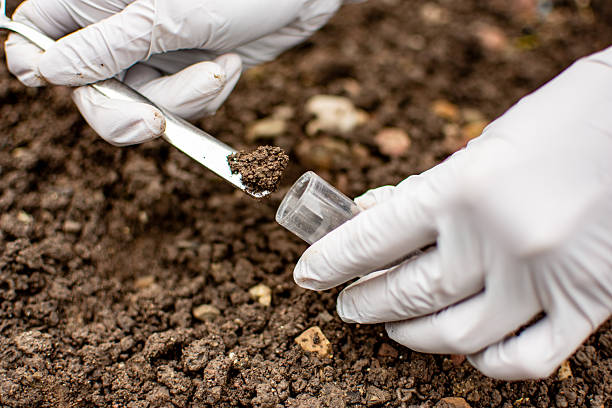
Soil is not uniform. pH varies across a plot, near paths and walls, and with depth. When I was taking measurements in the field, consistent placement was treated as seriously as the instrument itself, because a sample taken at a different depth or spot is not comparable to the one before it. One probe pushed into one convenient patch tells you about that patch and nothing more.
So whatever tester you use:
- Take samples from several spots, five or more across the area, and mix them into one composite sample before testing.
- Sample at a consistent depth, around 10 to 15 centimetres for beds, where the roots are working.
- Clear the surface first. Mulch and leaf litter have their own chemistry.
- Do not test straight after adding lime or fertiliser. Wait a few weeks for the soil to settle, or you are measuring the amendment.
- Damp soil, not dry or waterlogged. Probe meters need moisture to read at all, and very wet soil skews the result.
- Test the same way every time if you are tracking change. Same depth, same spots, same method.
How Often to Test
Less often than tester manufacturers would like. Soil pH changes slowly, over years rather than weeks, unless you have added lime or sulphur. Testing every three to four years is enough for most gardens, and after a major amendment.
That reframes the buying decision. If you need a number once every few years, a laboratory test is both cheaper and better than a meter that sits in a drawer between uses and drifts out of calibration.
Frequently Asked Questions
Are soil pH testers accurate?
Cheap ones are less accurate than they appear. Extension trials found home kits generally landed within one pH unit of laboratory results, and because pH is logarithmic, one unit is a tenfold difference in acidity. Digital meters with a glass electrode and calibration are far better, and a laboratory test is better still.
Do those cheap two-prong soil meters work?
They give a rough impression. They respond to how well soil conducts electricity, which depends on moisture, salts and compaction as well as acidity, so the number is not a direct pH measurement. Useful for a broad sense of acid or alkaline, not for deciding how much lime to add.
What is the most accurate way to test soil pH at home?
A digital pH pen with a glass electrode, calibrated with buffer solutions and used on a soil and water mixture rather than pushed into the ground. For a result you can act on with confidence, send a sample to a laboratory.
How often should I test my soil pH?
Every three to four years for most gardens, and again a few weeks after adding lime or sulphur. Soil pH changes slowly, so frequent testing rarely tells you anything new.
Why do I get different readings in different parts of my garden?
Because soil genuinely varies. pH differs across a plot, with depth, and near paths, walls and old building work. Take samples from five or more spots at the same depth and mix them before testing, so the reading describes the bed rather than one patch of it.
Should I buy a three-in-one meter that tests pH, moisture and light?
Not if pH is your reason for buying. Splitting a cheap device across three measurements does not make any of them better, and the pH function on these is usually the weakest.
Is a lab soil test worth the money?
For most gardeners, yes. It costs roughly what a mid-range meter costs, gives you nutrient levels alongside pH, and you only need it every few years. Extension services make the case that acting on a wrong number costs more than the test.