


Has your young tree grown taller than you, yet you can still wrap your fingers all the way around the trunk?
It sways a lot in the wind, the top flops over, and you are not sure it will ever hold itself up without a stake.
I have measured this myself. For a full growing season, I measured the height and stem thickness of 192 young silver birch trees every three weeks. What I learned is that a tree does not always grow taller and thicker at the same time. The trees I kept slightly warmer grew taller than the others, but their stems were no thicker.
So a tall, thin tree is usually not a sick tree. It is often growing in conditions that make it put its energy into height instead of trunk thickness. In most gardens, those conditions are easy to change.
Here is what I found, what usually causes it, and what I would do about it.
What I found when I measured 192 young birches
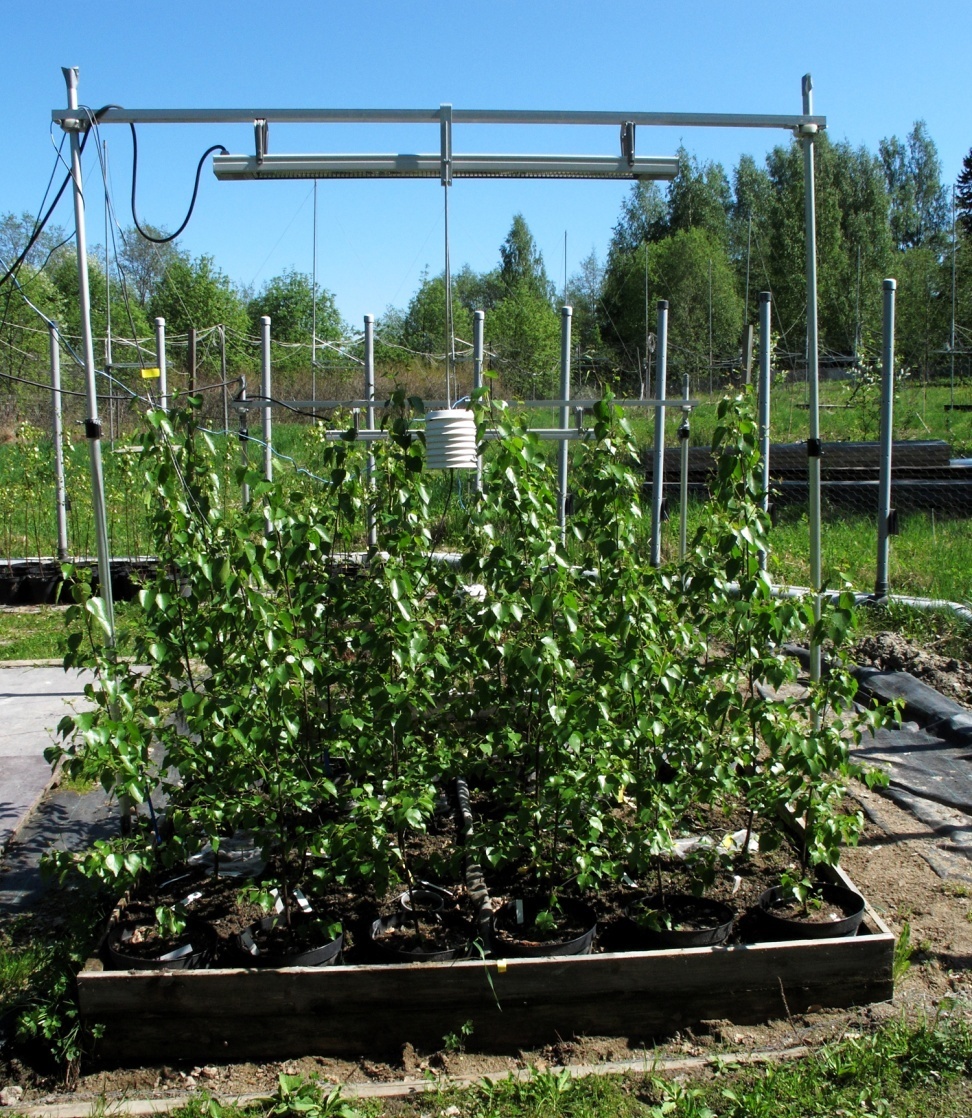
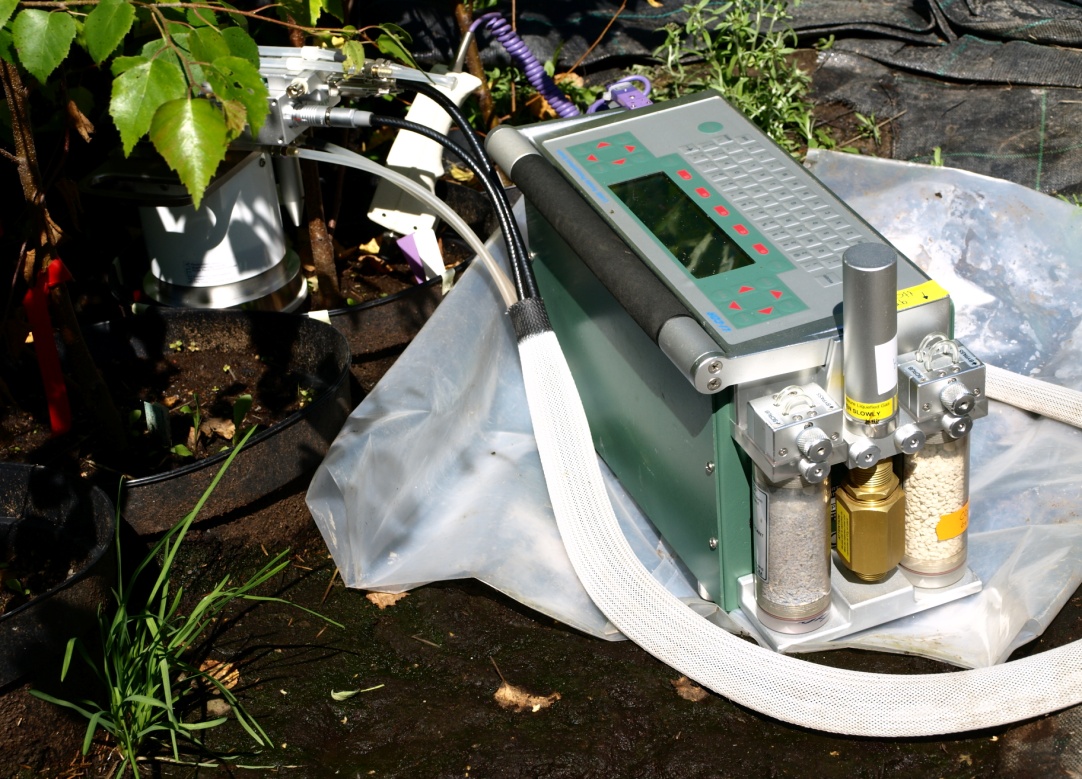
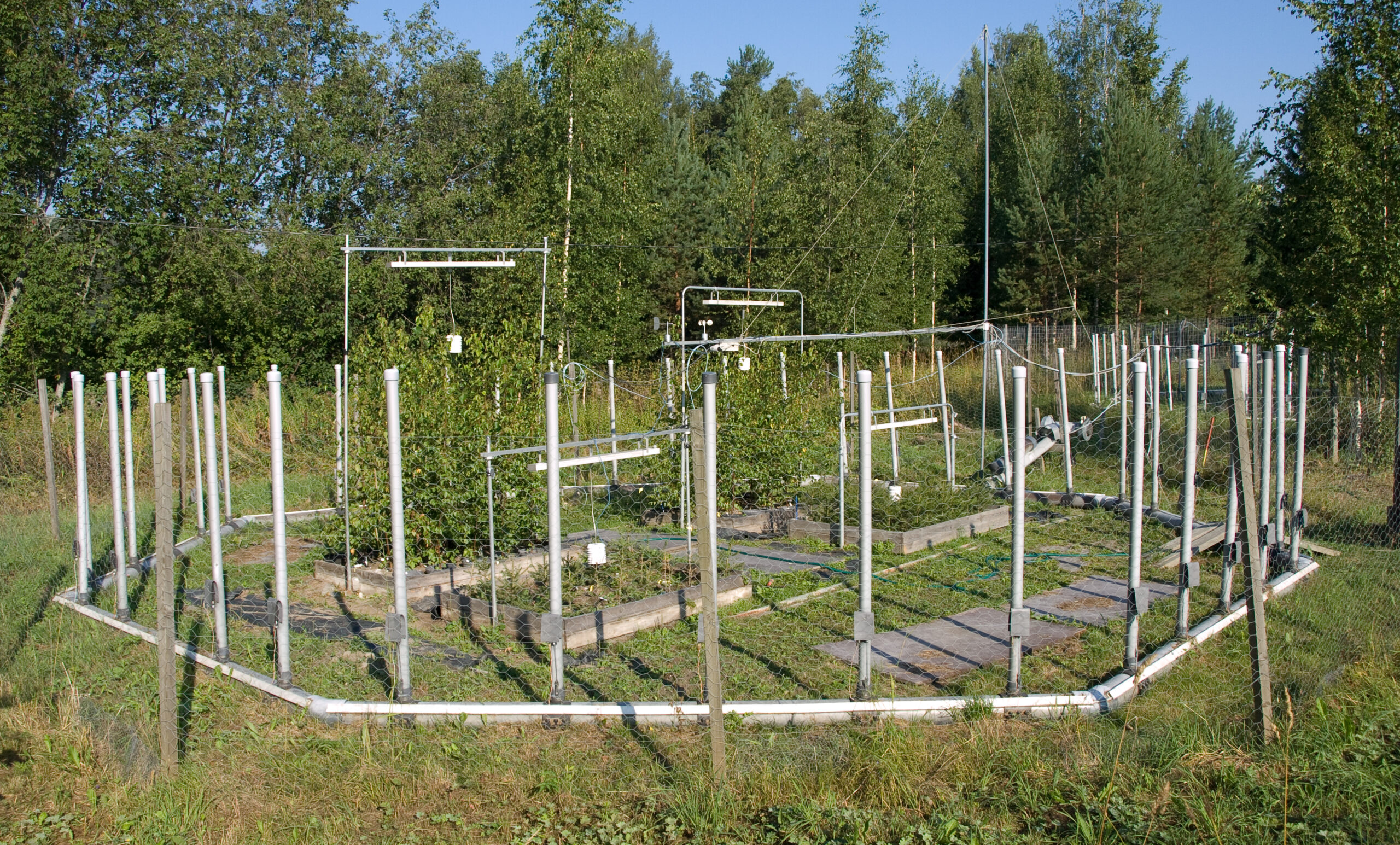
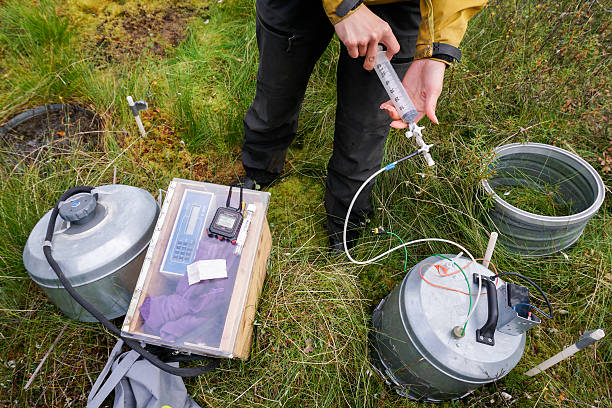
The trees were planted out in the field, in groups, and every three weeks for months, I measured all 192 of them. I marked the base of each stem with a marker pen, measured the diameter at that mark with a vernier caliper from two directions, and measured the height from the same mark to the tip of the stem. Using the same mark every time meant I was comparing like with like.
Some of the trees had infrared heaters hanging above them, which kept them about one degree Celsius warmer than the rest. As the trees grew, the heaters were raised so the distance between the heater and the top of the trees stayed the same all season.
This is what the numbers showed:
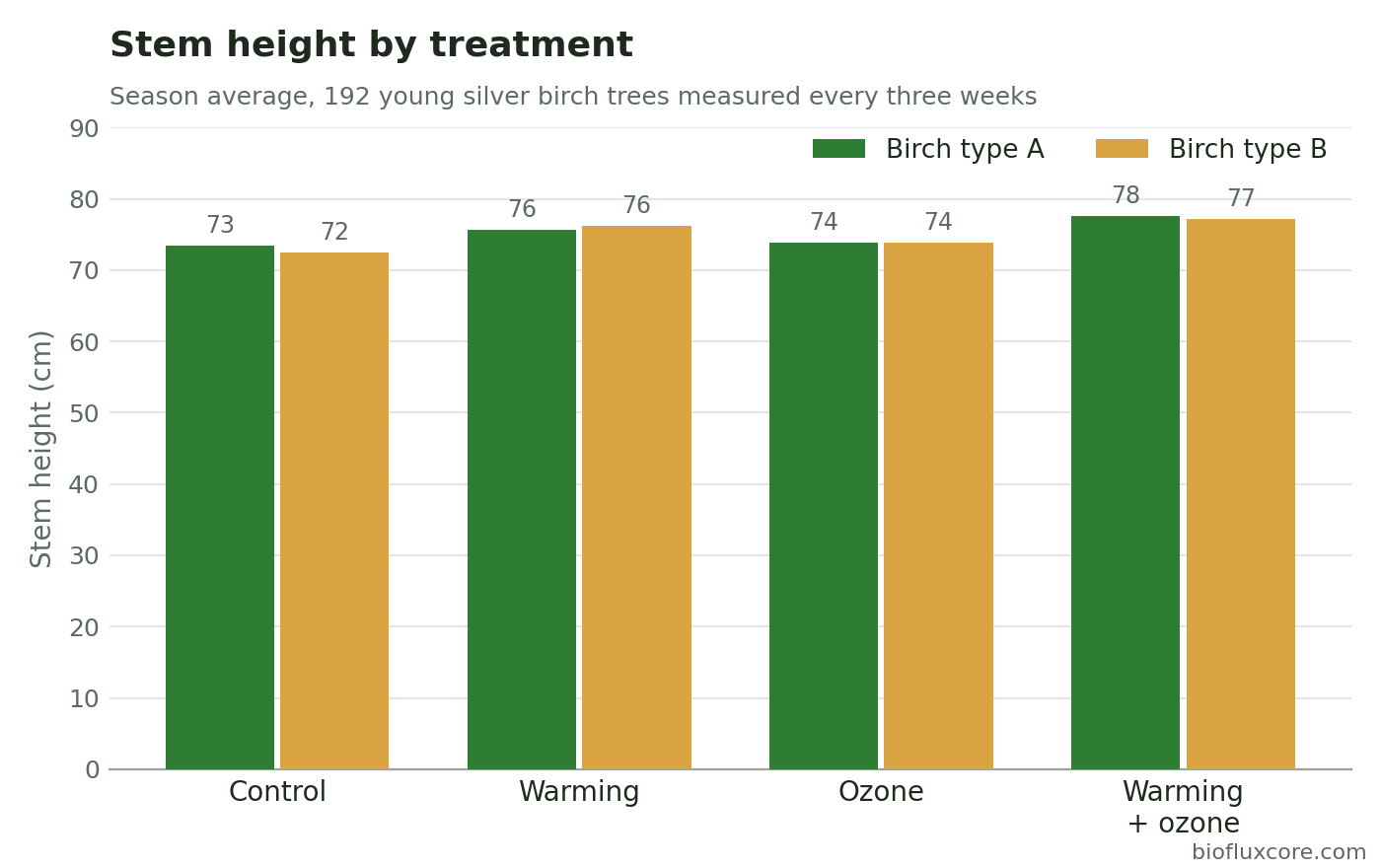
The warmed trees grew taller.
By mid-July they were about 9 percent taller than the trees at normal temperature. By August the difference had dropped to about 3 percent. Over the whole season it was about 4 percent, and it happened in both types of birch I was growing.
Their stems were not any thicker.
The warming made no difference to stem diameter. The extra growth all went into height.
The two birch types did the opposite.
They reached about the same height, but one type had thicker stems than the other in every treatment, all season.
So I had trees that got taller without getting thicker, and trees of the same height with different trunks. After seeing that, I stopped expecting height and trunk thickness to go up together. They react to different things.
Why this happens in a garden
My birches were affected by temperature, because that was what I was testing. In a garden, the usual causes are different, but the result is the same: the tree puts its growth into height.
Shade and crowding.
A tree that is short of light grows up toward it. Montana State University Extension says crowded young trees put on fast height growth to reach the light, at the expense of stem diameter growth, which makes them easy to bend or break (Montana State University Extension). A tree next to a wall, a fence, a hedge or bigger trees is the classic case.
A stake that holds it too still.
A trunk gets thicker partly because the wind bends it. If the tree is tied tight and high to a stake, the trunk barely moves, and it has little reason to build up wood at the base. The City of Seattle’s tree team puts it clearly: if a tree is staked too tight and does not move, the development of the trunk and roots is delayed (City of Seattle, Trees for Seattle).
Lower branches taken off too early.
The small branches low on the trunk make food that goes into the trunk below them. Oklahoma State University Extension says these lower branches add taper and strength to the trunk and protect young bark from the sun (Oklahoma State Extension). If the trunk has been cleaned up to a bare stem with a tuft at the top, it has lost that.
Too much fertiliser.
Feed that is high in nitrogen, including lawn feed spread near the tree, pushes soft new growth at the top.
How it was grown before you bought it.
Nursery trees are often grown close together in rows, so some arrive already tall and thin.
Four things I would check on your tree
| What to look at | What it tells you |
|---|---|
| Is it tied to a stake? How high, how tight, and for how long? | Tied high and tight for more than a year or two points to the stake. |
| Does the trunk have any small branches low down? | A bare trunk with leaves only at the top points to early pruning. |
| Is it in shade for much of the day, or close to other trees? | Shade or crowding points to light. |
| Has it been fed, or is lawn feed spread around it? | Regular feeding points to fertiliser. |
Most tall, thin trees I would expect to have more than one of these going on at once.
What I would change first
Move the tie down, or take the stake away.
Hold the trunk at different heights and find the lowest point where the tree stays upright by itself. Tie it there, loosely, so the top can move. Seattle’s guidance says ties should be on no longer than a year, and Oklahoma State says trees are usually stable within two growing seasons. If yours has been staked longer than that, try it without the stake on a calm day. If the root ball does not rock in the soil, leave the stake off.
Keep some lower branches.
Do not strip the trunk. Oklahoma State suggests keeping the temporary lower branches shortened to about 12 inches (30 cm) from the trunk in the first years. You can take them off a few at a time later, once the trunk has thickened.
Give it more light if you can.
Cut back what is shading it, or move or thin out plants that are crowding it. If it will always be in shade, it will stay slower and more upright, and that is fine as long as it is stable.
Stop feeding it.
Water it in dry spells and put mulch over the root area instead.
Then leave it alone for a season.
You will not see the trunk change in a few weeks. Over one or two seasons, the base should get noticeably thicker.
Signs I would not ignore
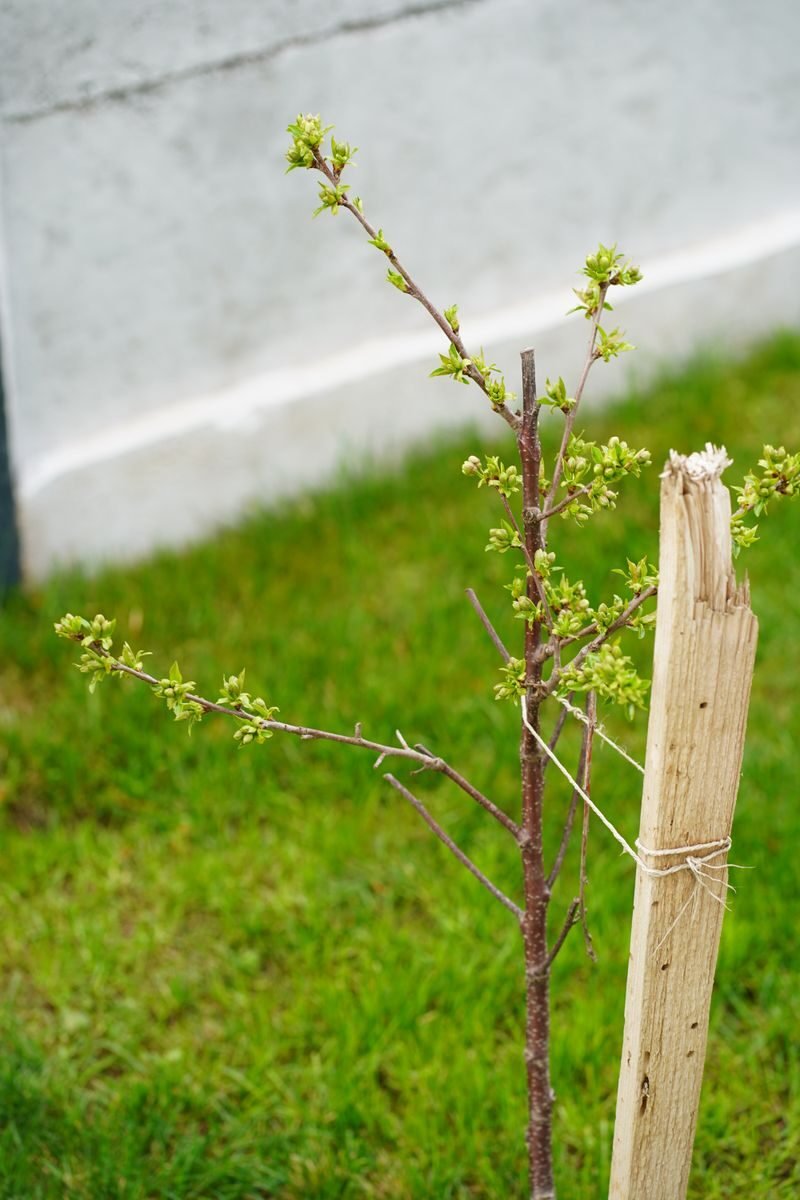
The tie is cutting into the bark. Loosen or replace it today. A tie left on too long can grow into the trunk.
The stake is rubbing the trunk. Rub wounds let disease in. Move the stake or pad the tie.
The tree leans and stays leaning after the wind drops. That can mean the roots have not anchored, or the trunk is damaged.
The soil lifts or cracks at the base when it moves. The roots are not holding yet. Keep a low stake on for another season.
If a bigger tree is leaning badly or the roots are lifting, get a qualified arborist to look at it.
How I would keep track of it
With my birches, measuring only height would have told me the warmed trees were doing better. Measuring diameter as well showed me their trunks were no thicker. For a tall, thin garden tree, diameter is the number I would watch most, because that is the one you are trying to change.
This is how I would do it:
Mark a spot near the base with a paint pen, and always measure there.
Measure the diameter with a caliper in two directions and take the average, or use a tape around the trunk and keep it level. Try to measure at the same time of day, ideally in the morning.
Measure the height from the same mark to the tip of the main stem.
Write it down every few weeks, with a note about the weather.
If the diameter starts going up after you move the stake or leave the lower branches, you know it is working.
My Tree Growth Rate Calculator works out a growth rate from two readings, and my Stem Diameter & Girth Converter converts between a tape and a caliper measurement. If you would rather have it all on paper, my Tree Establishment Tracker is a printable log for the first three years, with columns for height, stem diameter and watering, and a photo log.
If the trunk is measuring smaller than before, not just staying thin, have a look at My Tree Trunk Got Thinner. Is It Dying?. If the tree has hardly grown at all since you planted it, see I Planted a Tree Two Years Ago and It Is Not Growing.
Summary: Fixing a Tall, Thin Young Tree
A young tree that is tall and thin is usually growing in a way that favours height: too much shade, a stake that holds it too still, lower branches removed too early, or too much feed.
In my own birch trees, extra warmth added height and did nothing for stem thickness, so I know how different those two can be. Fix what you can from that list, let the trunk move, and measure the diameter, not just the height. Give it a season or two and you should see the base getting thicker.
FAQs
Why is my young tree tall and skinny?
Usually because something is favouring height: shade or crowding, a stake that holds it too still, lower branches removed too early, or too much fertiliser. Often it is more than one of these.
Will a thin tree trunk get thicker?
Yes, in most cases. Once the trunk can move, keeps some lower branches and gets enough light, it starts to thicken, mainly near the base. Expect to see it over one or two seasons.
Should I stake a tall, thin young tree?
Only if the root ball rocks in the soil. Tie it low and loose, at the lowest point where it stays upright, so the top can still move.
How long should a young tree stay staked?
Usually one to two growing seasons. Test it without the stake on a calm day. If it stands up and the root ball does not rock, take the stake off.
Should I remove the lower branches of a young tree?
Not yet. Shorten them to about 12 inches (30 cm) from the trunk and leave them for the first years. Remove them gradually once the trunk has thickened.
Does fertiliser make a tree trunk thicker?
No. Heavy feeding pushes growth at the top. Movement, light and lower branches are what thicken a trunk.
Is a tall, thin tree weak?
It bends and breaks more easily in strong wind or snow until the trunk catches up, so it is worth fixing the cause while the tree is young.