




Your moisture meter reads 22%. The guide you are following says to burn wood under 20%. So you wait another month.
But depending on who wrote that guide, your wood may already have been ready.
Moisture percentages come in two versions, a dry basis and a wet basis, and the same log gives two different numbers depending on which one you use. Most firewood advice never says which one it means.
Whenever I compare two percentages, the first thing I want to know is what each one is a percentage of. With firewood moisture, that one question clears up most of the confusion. And at the end of this guide, I will show you how to check your own meter at home with nothing more than a kitchen scale and your oven.
Two Ways to Say “20% Moisture”
Both versions start with the same thing: the weight of the water in the wood. They differ in what that water is divided by.
Penn State Extension defines them this way:
Wet basis: the water divided by the total weight of the wood, water included.
Dry basis: the water divided by the weight of the dry wood only.
The easiest way I know to see the difference is to work one log both ways. Say a split weighs 1.2 kg. You dry it completely in an oven and it weighs 1.0 kg. So it held 0.2 kg of water.
Dry basis: 0.2 ÷ 1.0 = 20%
Wet basis: 0.2 ÷ 1.2 = 16.7%
Same log, same water, two numbers. Neither is wrong. They answer slightly different questions.
Which One Your Meter Uses
Wood moisture meters follow the wood industry’s convention. The USDA Forest Service Wood Handbook (2021) states that for most wood products, moisture “is ordinarily expressed as a percentage of wood mass when oven dried.” That is a dry basis.
The handbook also describes oven-drying as the most widely accepted way to find moisture content, and the reference that meter readings are checked against. So when your pin meter reads 20%, it means the water weighs 20% of what the dry wood weighs.
This also explains something that puzzles a lot of people: how wood can be “over 100% moisture.” On a dry basis, a log holding more water than wood fibre goes past 100%. On a wet basis, that same log would only reach 50%. Penn State gives exactly that example: 50% on a wet basis is the same as 100% on a dry basis.
Which One the 20% Rule Uses
Here is where it gets messy. The most common advice, burn wood under 20% moisture, usually does not say.
The US Environmental Protection Agency says wood burns best at less than 20% moisture and recommends testing with a moisture meter, but does not name a basis. Fuel and bioenergy sources often work on a wet basis, as Penn State does when it discusses wood as a heating fuel.
The way I read it, that leaves two versions of the same rule:
If the 20% means dry basis, your meter should read 20% or less.
If the 20% means wet basis, your meter could read up to 25% and still meet it, because 20% wet is 25% dry.
That five-point gap is why two careful people can follow “the 20% rule” and disagree about the same stack.
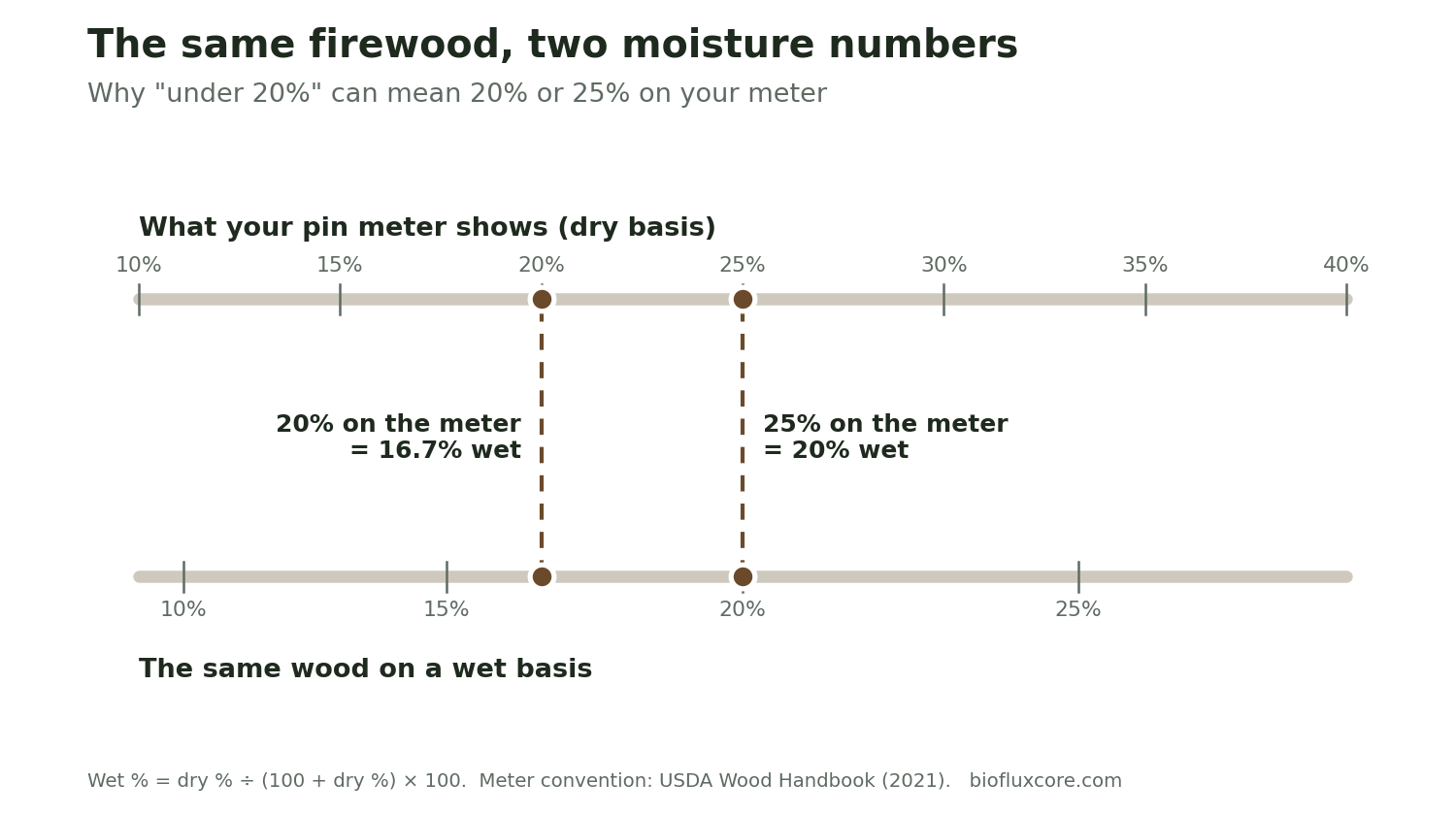
Converting Between the Two
The conversion is a single line of arithmetic:
Dry to wet: wet % = dry % ÷ (100 + dry %) × 100
Wet to dry: dry % = wet % ÷ (100 − wet %) × 100
If you would rather skip the maths, I have worked out the common values below. The left column is what a pin meter shows.
| Meter reading (dry basis) | Same wood on a wet basis |
|---|---|
| 15% | 13.0% |
| 20% | 16.7% |
| 25% | 20.0% |
| 30% | 23.1% |
| 50% | 33.3% |
| 100% | 50.0% |
Notice how the gap grows as wood gets wetter. At firewood levels it is a few points. At green-wood levels it is large, which is why fresh wood can read “over 100%” on one scale and “50%” on the other.
Check Your Meter at Home: The Oven Test
Every moisture number, on either basis, goes back to one measurement: weighing wood before and after drying it completely. This is the method the USDA Wood Handbook calls the most widely accepted. You can run a simple version at home, and I would do it once with any new meter. It shows you how close your meter reads to the true moisture of your own wood, and it makes the dry and wet basis numbers concrete.
What you need: a kitchen scale that reads to 1 gram (0.1 g is better), an oven, an oven thermometer, a saw, and your moisture meter.
- Take a meter reading first. Split a piece of firewood and measure the fresh face in the centre, three times, and write down the average.
- Cut a sample. Saw a slice about 25 mm (1 inch) thick from the middle of that split, not near the ends, which dry faster. Remove any bark. A bigger slice gives a more accurate result on a scale that reads only to 1 gram.
- Weigh it straight away. Wood starts losing water as soon as it is cut. Write down this “wet weight.” If you cannot weigh it immediately, seal it in a plastic bag until you can.
- Dry it at 101 to 105 °C (214 to 221 °F). This is the temperature range the handbook gives. Check it with an oven thermometer, because many home ovens run hotter than the dial says. Do not go hotter: wood that scorches loses more than water, and your result will read too high.
- Weigh it every 3 hours until the weight stops changing. The handbook notes a 25 mm lumber section takes about 12 to 48 hours. You can speed it up by splitting your slice into thinner sticks. If you need to stop overnight, switch the oven off and keep the sample in a sealed bag until you continue.
- Calculate both numbers. The final weight is your “dry weight.”
- Dry basis: (wet weight − dry weight) ÷ dry weight × 100
- Wet basis: (wet weight − dry weight) ÷ wet weight × 100
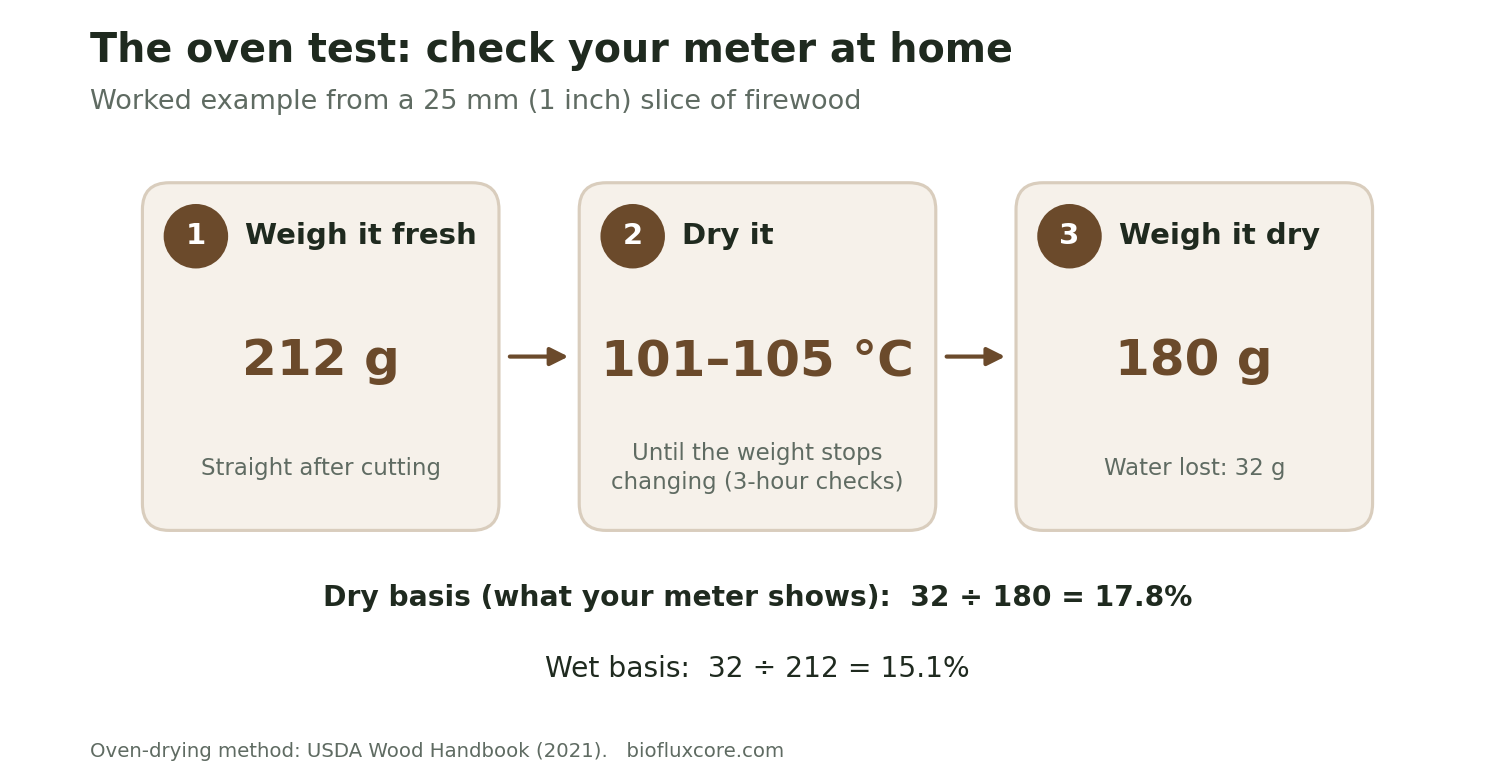
A worked example. Your slice weighs 212 g fresh and 180 g after drying. The water is 32 g.
Dry basis: 32 ÷ 180 × 100 = 17.8%
Wet basis: 32 ÷ 212 × 100 = 15.1%
If your meter read 19% on that same split, it was within about a point of the oven result on the same basis. For a quick handheld meter on firewood, that is a reading I would trust.
Safety: never leave the oven running unattended, do not use a microwave (wood can char and catch fire), and let the oven cool before removing the sample. The handbook also notes that very resinous woods can read slightly high with this method, because some of what they lose in the oven is not water.
What I Would Aim For
My advice is simple: aim for 20% or less on your meter.
A pin meter reads on a dry basis, and 20% dry is about 16.7% wet. That meets the 20% rule however it was meant. You never have to work out which basis a guide had in mind, because you are on the safe side of both.
If a reading sits between 20% and 25%, your wood may meet a wet-basis 20%, but I would treat it as borderline and give it more time, especially in winter, when cold wood already reads a little drier than it is. I explain that effect in why cold firewood reads drier than it is.
Quick Rules
These are the ones I would keep in mind:
Your pin meter reads on a dry basis: water as a share of the dry wood.
The 20% rule often does not say which basis it uses.
20% dry ≈ 16.7% wet. 20% wet = 25% dry.
Aim for 20% or less on your meter to meet the rule either way.
Run the oven test once to see how close your meter reads on your own wood.
When you compare numbers from different sources, ask first: percent of what?
To check whether your reading means the wood is ready, try my free Firewood Moisture Target Checker. If it needs longer, my Firewood Seasoning Time Estimator gives you an idea of how much.
Common Questions
Is a firewood moisture meter wet basis or dry basis?
Wood moisture meters report on a dry basis, the wood industry’s standard, where moisture is expressed as a percentage of the oven-dry weight of the wood.
What does 20% moisture content mean for firewood?
It depends on the basis. On a dry basis, the water weighs 20% of the dry wood. On a wet basis, the water makes up 20% of the total weight. A wet-basis 20% equals 25% on a dry basis.
Can wood moisture content be over 100%?
Yes, on a dry basis. If a log holds more water than dry wood fibre, the dry-basis figure goes above 100%. On a wet basis, the same wood would read below 100%, for example 50% instead of 100%.
How can I check if my moisture meter is accurate?
Run the oven test: weigh a slice of firewood, dry it at 101 to 105 °C until its weight stops changing, weigh it again, and calculate the dry-basis moisture. Compare that with your meter reading on the same split.
Should my meter read 20% or 25% before I burn?
I would aim for 20% or less on your meter. That meets the 20% rule whether it was meant on a dry or wet basis. Readings between 20% and 25% are borderline and usually worth more drying time.
Ask “Percent of What?”
A moisture percentage is only half a number until you know what it is a percentage of.
Your meter answers that for you: it reads on a dry basis. Aim for 20% or less on its screen, check it once against the oven test, and you are on the safe side of every version of the rule.